|
restoring our biblical and constitutional foundations
|

Patrick Cleburne, Confederate Hero
Today, March 17, is Saint Patrick’s Day. Patrick was a Christian missionary who lived from the late 4th century A.D. to the mid 5th century A.D. and who is credited with converting Ireland from paganism. For many celebrants, Paddy’s Day has come to epitomize all that foreigners seem to think being Irish involves—wearing green, getting drunk, eating plenty of food, saying “sure and begorrah,” or dancing like a crazed idiot.
There are, of course, many good reasons to celebrate Irish heritage today, not the least of which is to commemorate the life of a true Irish-American hero, Patrick Ronaynes Cleburne, born this day in 1828 at Annbrook House, Glenmore, in County Cork. Enlisting in the 41st Regiment of Foot, Cleburne’s unit was charged with maintaining order in a country racked by potato famine. In 1849 Cleburne moved to America and practiced law in Arkansas. In 1862 he received a commission as brigadier general in the Confederate Army. He was only one of two foreign born officers to attain the rank of major general in the Confederate armed forces.
In a letter to his family in 1861 he wrote, “I am with the South in death, in victory or defeat. I never owned a Negro and care nothing for them, but these people have been my friends and have stood up to me on all occasions. In addition to this, I believe the North is about to wage a brutal and unholy war on a people who have done them no wrong, in violation of the constitution and the fundamental principles of the government. They no longer acknowledge that all government derives its validity from the consent of the governed.”
Saner words were never spoken.
Cleburne’s
stellar military carrier brought him much-earned fame. At Chattanooga he
repelled Sherman, despite being outnumbered four to one. Later he won the
Battle of Ringgold Gap even though Hooker had three men for every one he
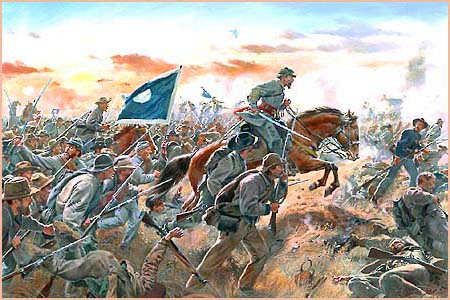 had.
During the Nashville Campaign he succeeded to the command of Hardee’s
Corps. Cleburne was killed in the battle of Franklin, Tennessee, on
November 30, 1864—one of six Confederate generals killed during that
famous battle.
had.
During the Nashville Campaign he succeeded to the command of Hardee’s
Corps. Cleburne was killed in the battle of Franklin, Tennessee, on
November 30, 1864—one of six Confederate generals killed during that
famous battle.
Cleburne’s military accomplishments earned for him the sobriquet “Stonewall of the West” (though some have insisted it is more accurate to call Jackson the “Cleburne of the East”). Despite fighting under less-than-capable officers, Cleburne repeatedly proved his military skill and bravery under fire.
Perhaps one event determined his military legacy more than any other. In January 1864, after the Confederate defeat at Chattanooga, Cleburne led a group of commissioned officers in proposing that the Confederate Army draft negroes in return for their emancipation. His reasoning seemed astute, both politically and militarily. Cleburne argued that in one stroke they could increase the size of the army and eliminate a reason for the Federals to fight. This proposal caused no little discussion in the South. When Confederate President Jefferson Davis decided to replace General Johnston during the Battle of Atlanta, he selected John Bell Hood over Patrick Cleburne—in part because of this proposal.
What led Cleburne to take the radical step of advocating emancipation for slaves who agreed to fight for the Confederacy? Thankfully, we have his thoughts in a letter he sent to the commanding general of the Army of Tennessee. The letter still repays careful reading 139 years after he penned it. Cleburne wrote these words:
“Moved by the exigency in which our country is now placed, we take the liberty of laying before you, unofficially, our views on the present state of affairs....We have now been fighting for nearly three years, have spilled much of our best blood, and lost, consumed, or thrown to the flames an amount of property equal in value to the specie currency of the world. Through some lack in our system the fruits of our struggles and sacrifices have invariably slipped away from us and left us nothing but long lists of dead and mangled. Instead of standing defiantly on the borders of our territory or harassing those of the enemy, we are hemmed in today into less than two-thirds of it, and still the enemy menacingly confronts us at every point with superior forces. Our soldiers can see no end to this state of affairs except in our own exhaustion; hence, instead of rising to the occasion, they are sinking into a fatal apathy, growing weary of hardships and slaughters which promise no results....
“Every man should endeavor to understand the meaning of subjugation before it is too late. We can give but a faint idea when we say that it means the loss of all we not hold most sacred—slaves and all other personal property, lands, homesteads, liberty, justice, safety, pride, manhood. It means the history of this heroic struggle will be written by the enemy; that our youth will be trained by Northern schoolteachers; will learn from Northern school books their version of the war; will be impressed by the influences of history and education to regard our gallant dead as traitors, and our maimed veterans as fit objects for derision....
“The President of the United States announces that ‘he has already in training an army of 100,000 negroes as good as any troops,’ and every fresh raid he makes and new slice of territory he wrests from us will add to this force. Every soldier in our army already knows and feels our numerical inferiority to the enemy....Our single source of supply is that portion of our white men fit for duty and not now in the ranks. The enemy has three sources of supply: First, his own motley population; secondly, our slaves; and thirdly, Europeans whose hearts are fired into a crusade against us by fictitious pictures of the atrocities of slavery, and who meet no hindrance from their Governments in such enterprise, because these Governments are equally antagonistic to the institution. In touching the third cause, the fact that slavery has become a military weakness, we may rouse prejudice and passion, but the time has come when it would be madness not to look at our danger from every point of view, and to probe it to the bottom. Apart from the assistance that home and foreign prejudice against slavery has given the North, slavery is a source of great strength to the enemy in a purely military point of view, by supplying him with an army from our granaries; but it is our most vulnerable point, a continued embarrassment, and in some respects an insidious weakness....Like past years, 1864 will diminish our ranks by the casualties of war, and what source of repair is there left us?
“Our country has already some friends in England and France, and there are strong motives to induce these nations to recognize and assist us, but they cannot assist us without helping slavery, and to do this would be in conflict with their policy for the last quarter of a century, England has paid hundreds of millions to emancipate her West India slaves and break up the slave-trade. Could she now consistently spend her treasure to reinstate slavery in this country? But this barrier once removed, the sympathy and the interests of these and other nations will accord with our own, and we may expect from them both moral support and material aid....This measure will deprive the North of the moral and material aid which it now derives from the bitter prejudices with which foreigners view the institution, and its war, if continued, will henceforth be so despicable in their eyes that the sources of recruiting will be dried up. It will leave the enemy’s negro army no motive to fight for, and will exhaust the source from which it has been recruited. The idea that it is their special mission to war against slavery has held growing sway over the Northern people for many years, and has at length ripened into an armed and bloody crusade against it.... A bloody ambition for more territory, a pretended veneration for the Union, which one of their own most distinguished orators (Doctor Beecher in his Liverpool speech) openly avowed was only used as a stimulus to stir up the anti-slavery crusade, and lastly the poisonous and selfish interests which are the fungus growth of the war itself. Mankind may fancy it a great duty to destroy slavery, but what interest can mankind have in upholding this remainder of the Northern war platform?
“The Constitution of the Southern States has reserved to their respective governments the power to free slaves for meritorious services to the State. It is politic besides. For many years, ever since the agitation of the subject of slavery commenced, the negro has been dreaming of freedom, and his vivid imagination has surrounded that condition with so many gratifications that it has become the paradise of his hopes. To attain it he will tempt dangers and difficulties not exceeded by the bravest soldier in the field....The slaves are dangerous now, but armed, trained, and collected in an army they would be a thousand fold more dangerous; therefore when we make soldiers of them we must make free men of them beyond all question, and thus enlist their sympathies also....
It is said that Republicanism cannot exist without the institution. Even were this true, we prefer any form of government of which the Southern people may have the molding, to one forced upon us by a conqueror....It is said slavery is all we are fighting for, and if we give it up we give up all. Even if this were true, which we deny, slavery is not all our enemies are fighting for. It is merely the pretense to establish sectional superiority and a more centralized form of government, and to deprive us of our rights and liberties.”
Ultimately, a number of Confederate leaders, including Robert E. Lee, advocated the enlistment of blacks. But it was not to be. The war had already been lost, and the tragic era of Reconstruction lay just around the corner.
Today we live in a humiliating time when civilization should be red-faced with shame. But there is a balm in Gilead and a hope from the Lord. John 8:36 says, “If the Son therefore shall make you free, ye shall be free indeed.” Our Lord Jesus Christ offers emancipation to every slave of sin. He has redeemed us out of the market place of sin and purchased us at the price of His life—a Declaration of Independence signed in His own blood! As a result, we enjoy that freedom from fear and worry and all the evils that would enslave us.
It is only when we become God’s captives that we are truly set free.
March 17, 2003
David Alan Black is the editor of www.daveblackonline.com.